A true Scotsman will seize any opportunity for a dram. Anytime. In the old Scottish days, it was common to enjoy whisky straight from the still, and it must have been a pleasure because they discovered that adding both honey and herbs gave the raw spirit a good taste. A method that seems ideal for cooking, but nothing really happened. However, the rumor spread that with good results one could store and let their whisky develop in wooden barrels. Perhaps something learned from sailors in the British Empire who discovered storing their rum, obtained through slave trade, in barrels. It made the drops easier to transport but also gave a taste and aroma that people really liked.
However, using whisky in cooking as an alternative to various wines is still a relatively new invention and because the British Isles are not particularly known for their gastronomic level, we must travel a bit around the world in our search. One of the first documented and recognized attempts to create a proper whisky dinner in more recent times was found in the USA at Pennsylvania State University in the late eighties. The goal was to investigate if good and well-aged whisky was suitable to replace wine both as a companion and as an ingredient. Participants were most interested in the different combinations of aromatic congeners one could encounter on such a journey, so it was more of a scientific experiment than an actual gastronomic mission.
"It has long been a small dream for both Olsen and me to combine our many years of love for good spirits with a good meal," says Ulrik Bertelsen. "And since we know Jan from the neighborhood, knowing that he can write, photograph, and cook, it was obvious to ask him."
"Fortunately, he was on board with the idea of making good food with real spirits, and our collaboration has now resulted in 'Mad med promiller #1.' We hope for further support from our suppliers so that we can create version #2 already this autumn," Ulrik Bertelsen concludes.
Grappa, cognac, calvados, pastis, and some good liqueurs are still missing. The big idea is to make the palette as wide as possible, so the plan for the next version is to fill in the gaps with an additional 25 recipes of delicious and exciting food with the missing spirits. The concept will remain the same, and this book will also be given to our customers when they purchase a bottle featured in the book. There will only be 1000 copies of this edition as well.
These two books will then be combined into one large book of about 140 pages filled with recipes, fine spirits, and supplemented with plenty of great stories about whisky, rum, gin, vodka, cognac, grappa, and pastis.
Everyone is welcome! Whisky.dk hopes that many will drop by in Sjølund on Saturday, August 5th, to help celebrate this release, where a new whisky, Murray McDavid Single Malt Auchroisk Bourbon Finish, will also be launched. There will naturally be opportunities to taste both this and that and get the cookbook signed by the author on the day of release.
Mat med promiller kokbok av Jan Ohrt
ISBN: 35210040
57 sidor
You can purchase the cookbook, but if you purchase one of the products below, it will be included in your purchase. (1 pc. pr. order):
Patridom Elixir de Ron
Tullamore D.E.W. Single Malt 18 år
Glenfiddich Our Original Twelve 12 år
Ragnarok Destilleret Økologisk Mjød
Little Isle Isle of Fionia
Hutchison's Ginger Wine
Benriach The Twelve 12 år
Distinctive Port Dalva
Boulard Calvados Pays d'Auge
Renegade New Age London Gin
The Whistler Irish Honey Whiskey Liquer
Pope Rum Co. The Original
Canaviais Cachca
Stoli Vodka The Original
Jack Daniels Tennessee Honey
Gunlöd Håndbrygget Økologisk Mjød
Mount Gay Black Barrel Est. 1703 Bardados Rum
Miles Rainwater Madeira Tinta Negra
Worthy Park Select Jamaica Rum
Bifrost Special Edition Økologisk Honningvin
Rammstein Stout Kraft Bier
Companero Ron Panama Extra Anejo
Xin Gub [Hsin Djin]
Bruichladdich The Classic Laddie
Glenglassaugh Sandend highland Single MaltQuinta Do Noval Black Reserve Port
Fary Lochan Sweet and Spi
cy Moscatel #01
Tanqueray London Dry Gin London Dry
Jack Daniel's Old no. 7 Tennessee Sour Mash Whiskey
Fary Lochan Gin Citrus
Highland Park 12 years old Viking Honour
Johnnie Walker Black Label 12 years old
Copenhagen Classic Gin
Talisker 10 years old Single Malt Scotch Whisky
Copenhagen Classic Vodka
The Singleton 12 years old Single Malt Scotch Whisky
Copenhagen Classic Single Malt Whisky
Wódka Vodka
Rum Nation Meticho Chocolate and Toffee
Boulder Spirits Straight Bourbon Whiskey
Ron Colón Salvadoreño Red Banana Oleo Rum
Ron Colón Rumzcal 33/66 Salvadoreño
Big Peat Whisky 12 years old
Søgaards London Dry Gin Organic
Windblown Whisky Søgaards Distillery Limited Edition Danish Whisky
Maclean's Nose Blended Scotch Whisky
Tequila San José Silver
Murray McDavid Single Malt Auchroisk Bourbon Finish
Mezclado, Dark C
Nordisk Brænderi Filippa Apple Brandy
Using spirits in your cooking is not a bad idea at all. No matter what food you prepare and which spirit you use, it will always enhance and add flavor. Everything from meat, fish, seafood, sauce, dessert, pickling, and glazing can benefit from a larger or smaller dram, and even a simple tart dough can be improved with a splash of good spirit.
This little cookbook you are holding in your hand is intended as a tribute to real food and good spirits. And by good spirits, we mean good spirits. Often, people think that when something doesn't taste quite right, you can just pour it into the food. Nothing could be further from the truth. When cooking with spirits, it's rarely for the sake of ethanol; most of it will evaporate anyway. What we're after are all the scents and flavors. So the first and most important rule is: Only use in your cooking what you enjoy drinking yourself!
Page 2: Maybe that's how it all began.
Page 4: Duck breast in port wine sauce.
Page 6: Hokkaido soup with whisky.
Page 8: Soy-baked salmon with gin.
Page 10: Grilled burger with whisky sauce.
Page 12: Gin & Tonic cheesecake.
Page 14: Salmon with mushrooms on whisky sauce.
Page 16: Whisky-infused veal tenderloin.
Page 18: Gin-marinated pork chop.
Page 20: Smoked cod with whisky.
Page 22: Is it okay to pour whisky into your food?
Page 24: Bloody Mary-infused oysters.
Page 26: Chocolate cake with berries and whisky.
Page 28: Crispy tuna with whisky dressing.
Page 30: Vodka penne.
Page 32: Rum balls with rum.
Page 34: Lobster with bourbon.
Page 36: Salvadoran party banana.
Page 38: Ceviche with giant shrimp.
Page 40: When rum was born.
Page 42: Grilled Côte du Boeuf.
Page 44: Gin-marinated chicken wings.
Page 46: Whisky-flambéed pork shank.
Page 48: Choripan with whisky chimichurri.
Page 50: Margarita sorbet.
Page 52: Roast pork with apple and onion.
Page 54: Chocolate fondant with rum.
Page 56: Eggs Benedict with apple brandy.
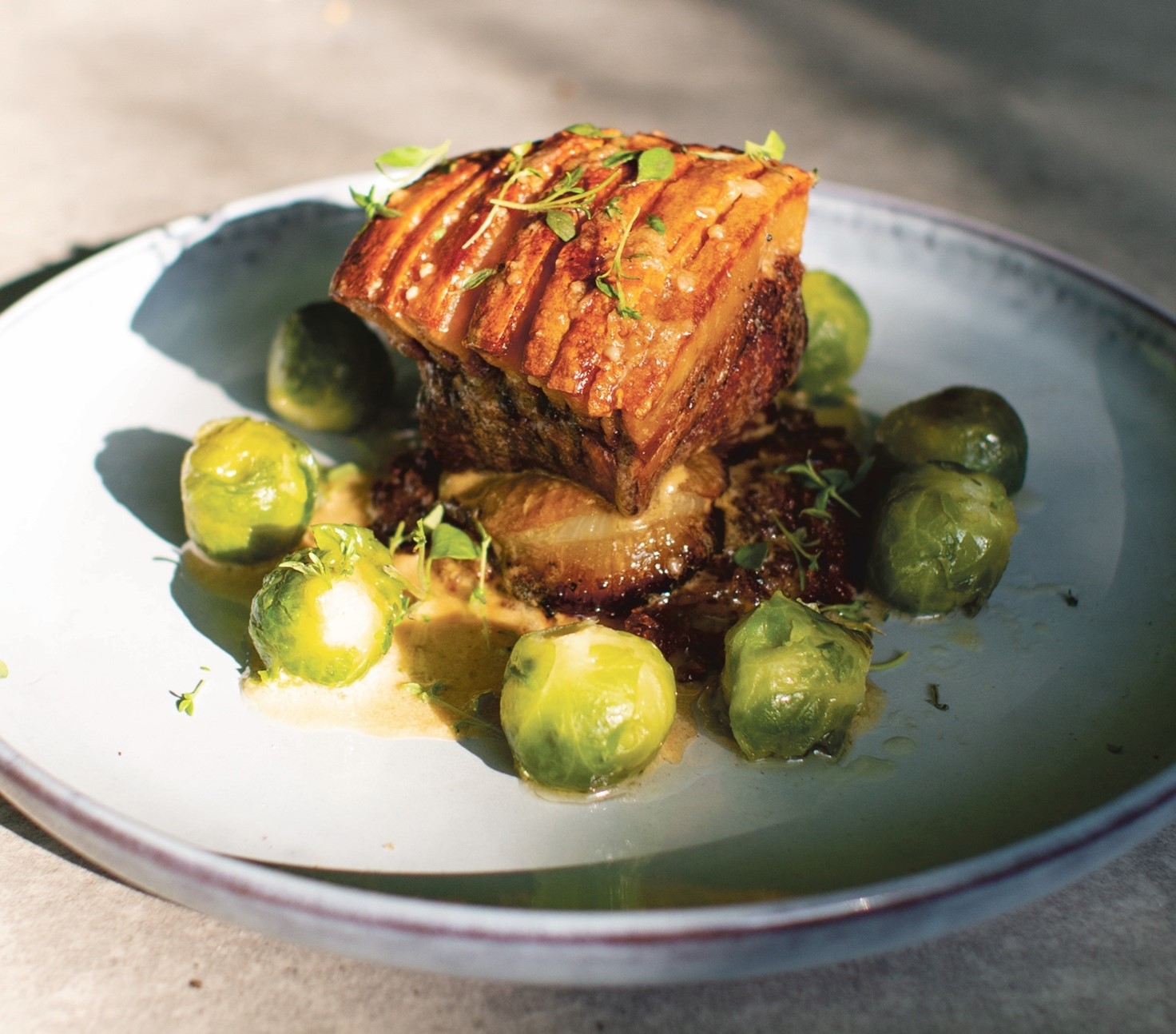
One of the dishes from 'Mad med Promiller #1' is this roast pork with apple, onion, and whisky sauce