


Flora & Fauna Whisky
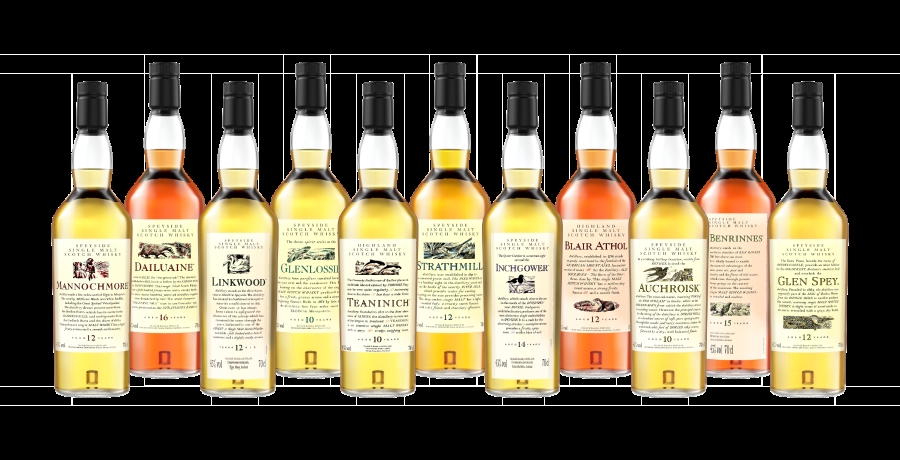
26 Scottish distilleries, one shared voice. Flora & Fauna is Diageo's secret treasure chest - the single malts that spent decades hiding inside blends, until someone decided to give them a glass of their own. |
About Flora & Fauna Whisky
Most of the distilleries behind Flora & Fauna historically sent almost all of their output into blended Scotch, rarely or never bottled as single malt under their own name. Flora & Fauna changed that. The series gave both whisky fans and the distillery workers themselves a rare chance to answer the question "what does this actually taste like on its own?" For the collector, Flora & Fauna remains one of the most accessible ways into closed or rare distilleries such as Rosebank and Pittyvaich, and a way to get hold of names Diageo has never built a standalone series around before or since.
The Flora & Fauna Series comes from these distilleries: Aberfeldy, Auchroisk, Aultmore, Balmenach, Benrinnes, Bladnoch, Blair Athol, Royal Brackla, Caol Ila, Clynelish, Craigellachie, Dailuaine, Dufftown, Glendullan, Glen Elgin, Glenlossie, Glen Spey, Inchgower, Linkwood, Mannochmore, Mortlach, Pittyvaich, Rosebank, Teaninich, Speyburn and Strathmill.
History & Background
The series was launched in 1991 by United Distillers, the forerunner of what is now Diageo, originally with no official name at all. It was whisky writer Michael Jackson who, in the 1994 edition of his book "Malt Whisky Companion", gave the collection the name Flora & Fauna, referring to the label illustrations of local plants and wildlife. A limited release of nine Cask Strength bottlings followed in 1997, and four more distilleries were added in 2001. The name has since stuck as one of the whisky world's most recognisable collector series.
Production & Style
Because each bottle in the series is tied to its own distillery, Flora & Fauna spans the entire Scottish flavour map - from Speyside's soft fruitiness to Islay's heavy smoke. Most editions are bottled at the standard 43%, while a handful were released at full Cask Strength. Cask policy also varies from distillery to distillery, and a few early editions came in wooden presentation cases, which today makes them sought-after collector pieces.
Signature Style
Versatile, Authentic, Distillery-true
Since each bottle carries its own distillery's signature, the flavour spans everything from Speyside's soft honey and apple, through Highland spice, to the peated smoke of Caol Ila. The shared trait is a raw, unblended character - whisky as it looks before it meets any other.
Facts
| Series | Flora & Fauna |
| Established | 1991 |
| Pronounced | FLO-ra og FAU-na |
| Region | Highland, Lowland, Speyside, Islay |
| Country | Scotland |
| Owner | Diageo |
| Number of distilleries | 26 |
| Official website | diageo.com |
Collector Appeal
Flora & Fauna has become one of the most hunted routes into closed distilleries. Bottles from silent distilleries such as Rosebank and Pittyvaich now trade at markedly higher prices than at launch, and the early wooden-case editions with white caps are considered among the series' most sought-after.
Did You Know?
Fewer than half of the original 26 distilleries in the series still produce their own Flora & Fauna edition today - several have closed, been sold off, or gone on to launch their own dedicated range under new owners.
If you like Flora & Fauna, you should also try:
You might also like Gordon & MacPhail Whisky, Signatory Vintage Whisky and Cadenhead's Whisky.